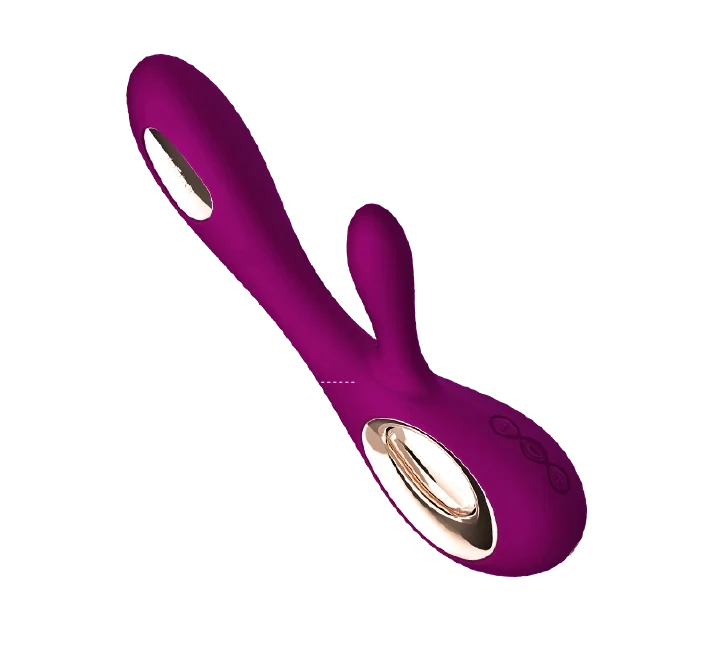
With SORAYA Wave, I’d want a clear answer to one question: am I interested in a moving internal tip?
That’s the reason I’d look at this model.
If I simply want a rabbit with vibration and straightforward changes of setting, the word Wave wouldn’t persuade me to add a mechanism I hadn’t been looking for.
The design is interesting when that movement is the point.
I’d still spend time on the relationship between the two arms, though.
It’s easy to notice the unusual part of a product and give the ordinary questions less attention.
Where will my hand go, and do I want the two contact areas joined in this shape?
What distinguishes this exact model
The official SORAYA Wave specification identifies WaveMotion, a flexible external arm, eight settings and a waterproof silicone-and-ABS construction.
LELO lists dimensions of 218 × 72 × 46 mm, a weight of 186 g and an insertable length of 110 mm.
Its published charging and use figures are both two hours.
Those facts establish the product's architecture.
They do not prove that its mechanical movement will be more enjoyable than vibration or that every setting will suit every person.
I would regard the mechanism as a distinct option rather than a universal upgrade.
Scroll sideways to see every column →
| Buying priority | How SORAYA Wave addresses it | Question to resolve |
|---|---|---|
| Mechanical movement | WaveMotion is the defining feature | Do you want movement as well as vibration? |
| Dual contact | Internal and external parts share one body | Does the spacing make sense for you? |
| Handheld control | The device remains a handheld rabbit | Is that how you want to manage positioning? |
| Routine care | Rechargeable, waterproof construction | What does the current manual require? |
SORAYA 2, SORAYA Wave and other products using the family name should not be merged into one generic review.
Their specifications and mechanisms differ.
Check the full name on the order page and manual, particularly when a retailer shortens its title to “SORAYA.”
The movement I’d have to want
The most useful question is what you expect the moving tip to add.
If you are simply hoping that an expensive mechanism must be better, I would pause.
A feature becomes valuable when it answers a known preference; otherwise it can make a purchase harder to evaluate without making it more suitable.
The internal movement also does not remove the importance of position.
Two linked contact areas still have to work together for the individual using them.
The ability to select a setting cannot compensate for a shape you do not find comfortable.
I would look at the proportions before comparing the pattern count.
An illustrative example makes the distinction clearer.
Someone who enjoys holding a device relatively still but wants the device to add movement may find the concept appealing.
Someone who prefers to control every change of position manually may not want that additional behavior.
Neither preference is more advanced; they are different reasons for choosing a tool.
I would avoid interpreting a promotional “finger-like” description literally.
It describes the intended character of a mechanism, not a promise to reproduce a person's touch.
That boundary matters because otherwise the review starts evaluating an imagined experience rather than the product actually documented.
Why the external arm still deserves attention
The Wave name draws attention inward, but the external arm remains half of the rabbit decision.
Its reach, flexibility and relationship to the main body can determine whether the combined format makes sense.
A buyer who only examines the moving tip may overlook the more basic fit question.
Overall measurements and insertable length answer different questions.
Overall length helps you understand storage and handling; insertable length concerns one part of the design.
Neither number describes how the entire shape will align with your anatomy.
Compare diagrams, and resist treating a photograph without scale as a reliable size guide.
If a previous rabbit failed because its external contact was wrong for you, I would want a specific reason to believe this outline addresses that problem.
A different motor mechanism alone is not that reason.
You may need a different external design or separate devices, rather than another variation of the same arrangement.
This is where an honest review has to leave room for uncertainty.
We cannot tell you how the arm will feel from a specification table.
We can identify the decision that remains unresolved, which is more useful than replacing that uncertainty with an invented comfort score.
The controls I’d want to understand
More functions make understanding the controls more important.
Before buying, I would read the manual to see how movement, patterns and intensity are selected, and how the device is stopped.
The best interface is the one the intended user can understand and operate, not necessarily the one that offers the most combinations.
Think about whether you usually keep one setting or switch frequently.
If you keep a stable setting, the range of options may matter less than a reliable route back to it.
If you change often, button placement and the sequence of actions can become central to the experience.
I would also keep the manual available after the first read.
Learning a mechanism once is different from remembering it after a long gap.
A clear explanation of the controls can save more frustration than another enthusiastic paragraph about intensity.
This review does not claim remote or internet control for SORAYA Wave.
A manufacturer having an app elsewhere in its range does not establish compatibility for this model.
If distance control is essential, verify a model that explicitly supports the required function rather than infer it from the brand.
The everyday details I’d check
Sound is one thing I’d investigate before ordering if I share a home and it matters to me.
I’d want a review that describes the room, distance and setting, rather than a reassuring adjective.
A moving mechanism is an interesting design choice; it isn’t a reason to guess what someone on the other side of a door will hear.
The same caution applies to battery duration.
A published use time is a reference point, not a booking guarantee for a certain number of evenings.
Charging habits, settings and battery age can change the result.
Plan around the actual manual and your own device rather than the most favorable interpretation of a table.
For maintenance, waterproof construction is relevant but does not authorize any cleaning method.
Follow the model-specific directions for products, drying and charging.
Do not transfer boiling or sterilizing advice from a non-electronic object to a motorized device simply because both have silicone surfaces.
These practical considerations are not reasons to dismiss SORAYA Wave.
They are reasons to evaluate the whole object.
A distinctive mechanism is only useful if you are also happy to hold, control, clean and store it.
When I would compare SVibe Snail Curve
SVibe Snail Curve deserves a look when your interest is a different external-contact design.
That is a deliberate change in emphasis.
SORAYA Wave's defining movement concerns its internal mechanism; Curve's moving external contact should not be presented as the same feature under another name.
I would retain SORAYA Wave as the more relevant candidate if its internal movement is specifically what attracts you.
I would look more closely at Curve if an external rabbit arm has been your main frustration.
The comparison works when it clarifies where you want the design to behave differently.
There is no evidence here that one mechanism produces better results for everyone.
Nor does the inclusion of SVibe establish that it is a cheaper purchase in your country after delivery and taxes.
Any price comparison needs the exact model, seller, destination and date.
Our individual Snail Curve review provides a separate assessment.
Treat it as another design to examine, not an instruction to buy both.
If your current product already does what you want, an unfamiliar mechanism is a reason for curiosity rather than an obligation to upgrade.
What would make me choose SORAYA Wave?
I would shortlist SORAYA Wave if I wanted its moving internal mechanism, understood the dual-contact fit question and was willing to learn the controls.
I would hesitate if I only wanted a straightforward external vibrator or was choosing mainly on the assumption that more moving parts mean more value.
Before ordering, confirm the exact generation and the seller's applicable terms.
Manufacturer product pages can contain general promotional or warranty language that is less clear than a country-specific policy.
An attractive product description should not make an unresolved return condition disappear.
SORAYA Wave has a clear reason to exist.
Its value lies in how well that reason matches your preferences.
For me, it earns a place on a specific shortlist for mechanical movement; it does not automatically displace a simpler rabbit, an external device or a product you already find comfortable.
Related reading
For a broader comparison, read SVibe Snail Curve vs LELO SORAYA Wave: Are They Worth It?.
For a separate assessment of another design in this range, see SVibe Snail Curve review: where the rolling design earns its place.
I’d keep SORAYA Wave in the running if internal movement were the change I wanted to make.
If my attention kept returning to the external arm, I’d spend more time with the Curve comparison instead.
Those are different starting points, and I’d rather settle mine before looking at an offer.
There’s no obligation to choose the most elaborate object in the range when a simpler one fits the brief I actually have.